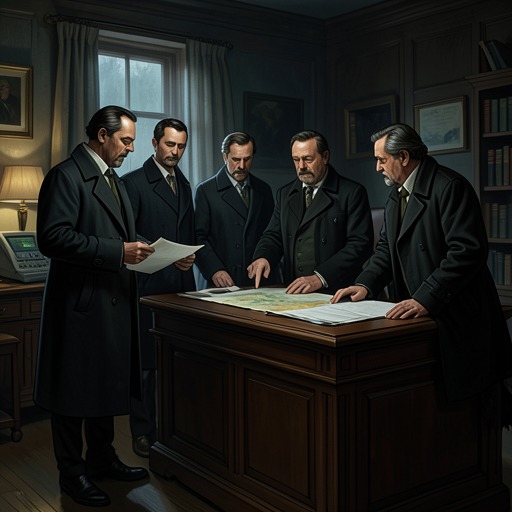
The Musketeers' Secret Missions
The Three MusketeersThe Musketeers' Secret Missions form a compact intelligence campaign conducted by Athos, Porthos, Aramis, and d'Artagnan during the siege of La Rochelle. Rather than relying on official institutions, the four friends divide the work between Planchet and Bazin, sending one messenger toward England and the other toward Tours. Their purpose is both protective and retaliatory: to alert Lord de Winter to Milady's crimes and plans, to warn Buckingham of an impending assassination, and to preserve the wider network of loyalties threatened by political intrigue.
Causes and Background
The missions arise from the danger posed by Milady and from the unstable political world surrounding the siege. La Rochelle is invested, the dyke blocks the arrival of the English fleet, and the cardinal's political power makes ordinary channels of communication unsafe. The four friends are already living under constant apprehension: they watch the cardinal's movements, listen for news from arriving couriers, and fear that Milady's presence may expose or destroy them. Their operation therefore answers two connected crises—an immediate threat to Buckingham and Lord de Winter, and the larger problem of communicating across enemy territory while surveillance, arrest, and political persecution remain possible.
The decision also reflects a world in which official justice and secret power overlap. A suspected person may be seized through a concealed police operation known as a mousetrap, in which visitors to a house are admitted and then arrested one after another. Athos has himself been taken to Fort l'Eveque on an order that officials refused to show, while M. de Treville argues before Louis XIII that such treatment exposes the King's Musketeers to infamy and persecution. The four friends consequently trust personal bonds and carefully chosen agents more than public procedure. Their secret missions are a practical response to a state where an edict forbids fighting, yet political authorities manipulate arrest, judgment, and punishment according to expediency.
The Letters and Their Concealment
Aramis prepares the Tours message in a graceful female hand and addresses it to Mlle. Michon, seamstress, Tours, the identity used by Marie Michon. The letter presents itself as private family correspondence, but its language carries a political warning. It tells Aramis's cousin that the cardinal is close to ending the rebellion at La Rochelle and claims that Buckingham will be prevented from departing by a great event. Its apparent dream that the Englishman is dead disguises a prediction of danger beneath extravagant praise of the cardinal. The friends recognize that such rhetoric can pass as harmless flattery while still conveying urgent intelligence.
The message intended for Lord de Winter is more direct. Aramis writes that the recipient has twice nearly fallen victim to a near relative whom he believes to be his heir, because he does not know that she was already married in France before marrying in England. The letter warns that the third attempt may succeed, explains that the relative has left La Rochelle for England, and directs Lord de Winter to study her past on her left shoulder. The reference identifies the physical mark that exposes Milady's history, turning a seemingly personal warning into evidence of her concealed identity and criminal past.
The agents are selected for personal reasons as well as practical ability. Aramis insists that only Bazin can carry the Tours letter because his cousin knows and trusts Bazin alone. Bazin is ambitious, learned, and hopes eventually to enter the Church, perhaps even to become a cardinal; the friends therefore believe he would endure torture rather than betray the mission. D'Artagnan chooses Planchet for England because Milady once had him expelled and beaten with a stick. His memory, knowledge of London, and desire for vengeance make him a particularly reliable bearer. The plan is not merely logistical: it converts humiliation and loyalty into security.
Planchet's Mission to England
Planchet receives three incentives in deliberate order—money, glory, and danger—before being given his instructions. He proposes hiding the letter in the lining of his coat and, if captured, swallowing it. The plan reveals the extreme value placed on secrecy, even though d'Artagnan points out that destroying the letter would also prevent the commission from being completed. Planchet nevertheless promises that no portion of him would speak even if he were cut into quarters, presenting bodily endurance as the ultimate guarantee of confidentiality.
He is scheduled to leave at eight o'clock the following morning, learn the letter by heart during the night, and return by eight o'clock on the sixteenth day. He rides an excellent horse for the first twenty leagues, after which he is to take the post. The timetable gives the mission a precise operational structure, while the use of memorization and changing transport acknowledges the risks of interception. Planchet's departure is therefore both adventurous and methodical: courage is supported by advance planning, money, routes, deadlines, and a document that can be concealed or destroyed.
D'Artagnan adds a second warning that is more serious than the written message. After Planchet has delivered the letter to Lord de Winter, he must tell him to watch over Buckingham because assassins intend to kill him. D'Artagnan deliberately withholds this secret from his three friends and refuses to write it down even for the sake of a captain's commission. The instruction establishes a private chain of trust between master and servant and shows how the mission expands from warning Lord de Winter about Milady to attempting to prevent Buckingham's assassination.
Bazin's Mission and the Replies
Bazin leaves for Tours the following day and receives eight days to complete his commission. His task is less physically dramatized than Planchet's journey, but it is equally important because the disguised correspondence must reach Marie Michon through the one intermediary whom Aramis's cousin trusts. The four friends remain alert during both absences, waiting for couriers and watching the cardinal's actions while also protecting themselves from Milady. Their anxiety gives the missions a suspended quality: the travelers are absent, but every delay or unexpected service may signal discovery.
On the eighth morning, Bazin returns to the cabaret of the Parpaillot while the four friends are eating breakfast. He uses the agreed phrase, reporting that he has the answer from Aramis's cousin. The friends exchange a joyful glance because the first half of the operation has succeeded, although they understand that the easier half is over. Athos reads the reply aloud to disperse suspicion. Marie Michon answers that she and her sister are skilled at interpreting dreams and fear them, but hopes Aramis's dreams are illusions; she tells him to take care of himself and act so that they may continue to hear of him. The reply is affectionate, cautious, and deliberately indirect, preserving the correspondence's appearance as family communication.
The English response is far shorter. When the four friends finally reach their tent, with Planchet guarding the entrance, d'Artagnan opens the anxiously awaited letter with a trembling hand. It contains only the words "Thank you; be easy." Athos immediately burns the paper at the lamp until it is reduced to cinders. The contrast between the elaborate warnings sent outward and the compressed reassurance sent back inward dramatizes the conditions of clandestine communication: a single brief acknowledgment can confirm that the message has arrived, while the destruction of the original prevents it from becoming evidence.
Consequences and Significance
The missions convert the four friends' fellowship into a distributed network capable of acting beyond the battlefield. Planchet's journey links the group to Lord de Winter and Buckingham in England; Bazin's journey maintains Aramis's connection with Marie Michon in Tours. Both servants become active participants in the political struggle, not passive attendants. Their loyalty is grounded in distinct motives—Bazin's ambition and discipline, Planchet's memory, gratitude, and vengeance—yet both are entrusted with matters on which the four friends' safety and the lives of powerful allies depend.
The operation also exposes the precarious balance between private justice and public authority. The friends work around institutions that can arrest secretly, withhold warrants, and judge according to political necessity. Their letters must therefore conceal their meaning behind dreams, family language, and coded references, while their couriers must be paid, briefed, timed, and protected. In this setting, communication itself becomes an act of resistance. The missions do not end the threat posed by Milady or resolve the violence surrounding La Rochelle, but they establish a counterforce to her mobility and the cardinal's machinery of surveillance.
Their later significance is sharpened by the documents that surround the wider conflict. Athos can halt an execution when Milady produces a paper declaring that an act was done by the cardinal's order and for the good of the state; later, the cardinal condemns those who punish without legal authority as assassins. Against such official and quasi-official instruments, the secret missions offer another form of authorization: the authority of mutual loyalty, personal knowledge, and responsibility for endangered lives. The event thus stands as a miniature of the novel's larger political world, where letters, signatures, disguises, and messengers can alter the balance between protection and destruction.